Couple Sparks Outrage Over Their Bizarre Engagement Party Dress Code: ‘I’m Sorry WHAT?!’


uaetodaynews.com — Couple sparks outrage over their bizarre engagement party dress code: ‘I’m sorry WHAT?!’
A couple who provided guests with an elaborate engagement party dress code has sparked a heated debate online.
The future bride and groom sent a lengthy message to guests ahead of the celebration, which included a 75-word ‘old money’ dress code.
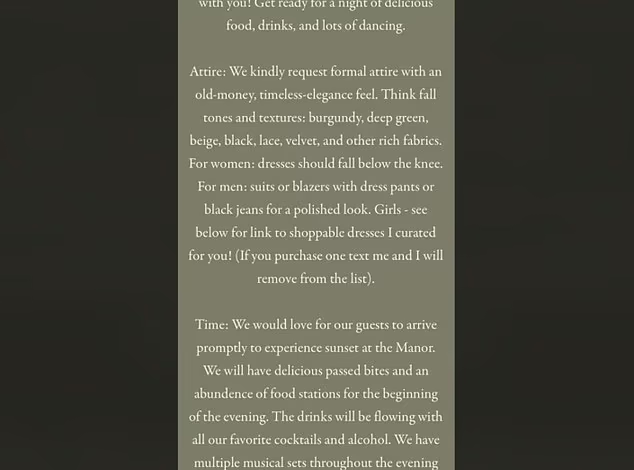
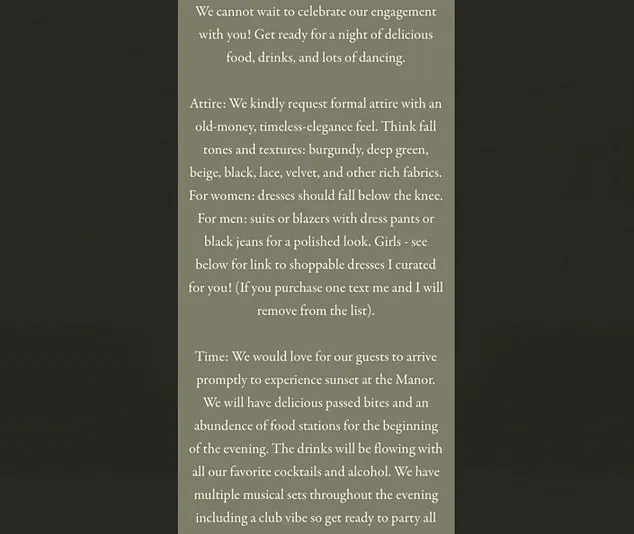
The message accompanying the invitation started innocently enough, with the couple sharing that they ‘cannot wait to celebrate’ and looked forward to ‘a night of delicious food, drinks, and lots of dancing’.
But things took a turn in the following paragraph, titled ‘Attire’.
The couple went on to provide intricate details about what the hosts expected their guests to wear.
‘We kindly request formal attire with an old-money, timeless-elegance feel,’ they wrote.
‘Think fall tones and textures: burgundy, deep green, beige, black, lace, velvet, and other rich fabrics.’
In addition to dictating outfit colours guests should wear, the bride and groom-to-be took the explanation a step further by also specifying the precise details of guests’ garments.
‘For women: dresses should fall below the knee,’ the dress code read.
An engaged couple provided guests with an elaborate engagement party dress code – with a picture of the detailed message shares in a recent Reddit post
‘For men: suits or blazers with dress pants or black jeans for a polished look.’
But it didn’t stop there. The explanation continued with the future bride saying she had ‘curated’ a ‘link to shoppable dresses’ for girls attending the party.
‘Girls – see below for link to shoppable dresses I curated for you! (If you purchase one text me and I will remove from the list).’
The over-the-top message continued with a final paragraph demanding guests arrive ‘promptly’ for an evening of ‘food stations’, ‘multiple musical sets’ and ‘all our favourite cocktails’.
A picture of the message was shared to Reddit and immediately attracted thousands of upvotes and hundreds of comments.
Online pundits took great issue with the couple imposing such an elaborate dress code on their guests.
‘These young brides are getting crazy!’ replied a professional wedding planner.
‘I’ve never seen so much emphasis on guest fitting the colour, palette and giving so many details on exactly what to wear. As an event planner I appreciate a nice aesthetic and a themed event, but adding exact dress links to a list is a little too far.’
The future bride and groom shared a 75-word dress code to guests, requesting that they wear ‘request formal attire with an old-money, timeless-elegance feel’ (Picture: stock image)
But it was the ‘old money’ line contained within the dress code that attracted the most criticism..
‘Anyone asking for something to be “old money”… is not,’ replied one person.
‘People who are actually from old money families would never say the word “money” in a wedding invitation. Vulgar and gauche,’ another added.
‘Old money and a curated list of dresses? Wow – I am embarrassed for the person that sent this.. and a bit concerned about how out of touch with life they are to think it’s ok,’ one more wrote.
Furthermore, many picked up on a contradiction contained within the dress code.
Namely, that while the couple wanted an ‘old money’ sophisticated vibe, they also allowed ‘black jeans’ for men and encouraged ‘dancing your a*s off’.
The elaborate engagement dress code sparked online furore on Reddit, with pundits noting that it seemed contradictory to request an ‘old money’ dress code while simultaneously telling guest to prepare to ‘dance your ass off’ (Picture: stock image)
‘Old money and black jeans is an oxymoron,’ read part of another message.
Many responses were particularly incredulous that female guests were beholden to such a high standard of dress code, while men could get away with far more casual black jeans.
‘So women MUST wear dresses, and they can’t even buy the same one as other guests – but men’ can wear JEANS?’ read one reply,’ which echoed many others throughout the comments.
Furthermore, some commenters suggested the ‘curated’ dress suggestions were in fact an affiliated link, meaning the future bride would get a kick back on any purchases.
‘Mind you she gets commission off the links she included, just when you thought it couldn’t possibly get any tackier.’
But one commenter summed it up best, saying: ‘(A)ll of this for an engagement?! Good luck with the wedding…’
Disclaimer: This news article has been republished exactly as it appeared on its original source, without any modification. We do not take any responsibility for its content, which remains solely the responsibility of the original publisher.
Disclaimer: This news article has been republished exactly as it appeared on its original source, without any modification. We do not take any responsibility for its content, which remains solely the responsibility of the original publisher.
Author: uaetodaynews
Published on: 2025-10-16 23:03:00
Source: uaetodaynews.com