Colorado District Teaches Cutting-Edge Skills Needed For A Changing Workplace The 74
Get stories like this delivered straight to your inbox.Sign up for The 74 Newsletter
Get و stories و like – تفاصيل مهمة
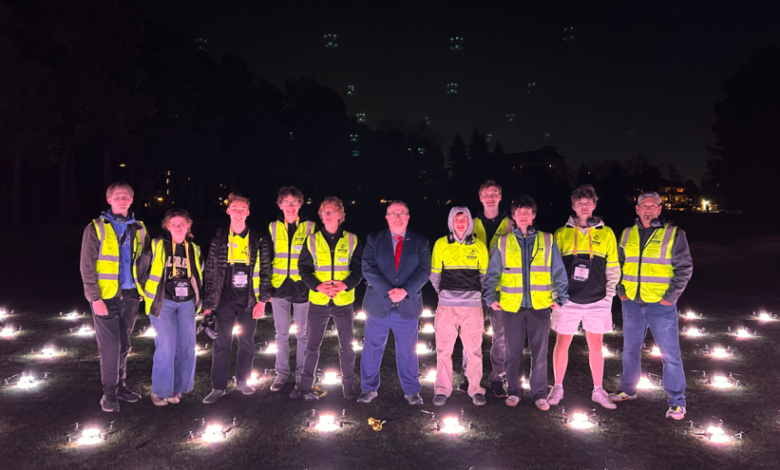
The stage was set, the drones were lined up, and education representatives from across Colorado gathered to watch. Students from St. Vrain Valley Schools, members of the first high school drone team in the country, prepared to send 200 small flying devices into the air and shape them into breathtaking formations, in front of the historic Broadmoor Hotel in Colorado Springs.
Up went the drones, and then, suddenly, down went the drones. A frequency conflict resulted in the team losing control of their devices, only to watch them crash back to earth, many of them destroyed. As their district’s superintendent and other attendees of the Colorado Association of School Boards conference helped them literally pick up the pieces, the students were shocked.
“The kids were crushed,” said Joe McBreen, the assistant superintendent of innovation at the Longmont, Colorado, school district. “They felt like they failed their superintendent.”
When the students diagnosed the problem, they realized that linking the next set of drones to a secure certificate online would avoid the connection mishap. Nearly a year and 40 shows later, “they haven’t had a problem since,” said McBreen.
the و of و and – تفاصيل مهمة
“Tell me where kids can learn that lesson and which standardized test” will mark that progress, said Axel Reitzig, the executive director of innovation for the 33,000-student district located 50 miles north of Denver.
St. Vrain’s website boldly claims its students “are the future of America,” and once you peek inside its 50,000 square-foot Innovation Centerthat phrase seems less like a boast than a statement of fact. In addition to the district’s 260 competitive robotics teams, there are groups of students raising an endangered species of frogs, another group building and designing airplanes, as well as students taking classes in artificial intelligence, cyber security and music innovation.
St. Vrain’s has been honing its career technical education offerings for than a decade, pushing not just new fields of study, but encouraging students to dive deeply into one or career paths, with the goal of cultivating a hybrid set of skills that can set them up to thrive in a changing workforce.
Career technical education is undergoing a renaissance, with 15% of high school classes in the U.S. offering students instruction that focuses on the skills and knowledge required for specific jobs or fields of work, according to a 2024 National Center for Education Statistics report. This type of learning boosts student achievement, graduation rates, hirability, and college readiness, according to recent research from the nonprofit American Institute for Research.
of و a و the – تفاصيل مهمة
While not all of St. Vrain’s Innovation Center classes and training fit the strict definition of career technical education, all of it has been created to help students “test drive a career,” Reitzig said.
The district appears to be on the right track. A recent survey of seniors at the Innovation Center showed that 98% of them correlated what they did in high school to what they hope to do as a career.
St. Vrain’s also has one of the highest graduation rates in the state at 94.3% for 2023-24, well in front of the state’s average 84.2% rate. The district’s attendance for the same period topped 92%, again ahead of the state’s average.
St. Vrain opened its 6,000-square-foot Innovation Center in 2014 with five staffers offering 10 classes that sought to teach high school students technical skills or project management experience in fields like robotics and coding.
Three years and a successful bond measure later, the Innovation Center has mushroomed into a 50,000-square-foot “sandbox” offering 70 classes to than 1,200 students districtwide. A newly approved expansion will soon double the center’s size, Reitzig said.
The district’s philosophy is that students’ experiences should progress from exploration of various fields to education within those areas to real-world experience. Each of its 26 elementary schools, for example, has two annual field trips to the center, and high school students are encouraged to begin classes in one of 11 different focus areas as a freshman, allowing them to specialize by the time they graduate. The district even pays 200 students for work they complete after school for area companies, local government, or the district itself.
to و the و students – تفاصيل مهمة
“These students are doing authentic work for real clients,” Reitzig said. “They are going out and earning contracts.” He added that this work, in some ways, can be valuable than an internship because students get to lead projects and learn from their failures.
The center maintains a strong relationship with a variety of business owners and entrepreneurs in the greater Denver area.
Mikki McComb-Kobza of Ocean First Institute first started working with St. Vrain students several years ago when she was seeking a way to verify the sizes of great white sharks without catching them. Students helped design a photography system using lasers to measure sharks underwater.
Since then, the nonprofit’s CEO has seen students find “their passion and purpose” through science experiments that have led to publishable research. “They allow students to get in the mud, next to other scientists,” she added. The district is open to hearing suggestions on what she called “dream moonshots” in various conservation projects.
to و a و the – تفاصيل مهمة
“Axel never says no,” she added, referring to the district’s executive director of innovation.
The best example of this experimentation came when Mac Kobza, a senior wildlife biologist for Boulder County, asked the district’s students how they could help counter the declining number of Northern Leopard frogs, a species native to the area. After securing state approval, the district purchased tanks and set out to create a system to raise these frogs in captivity before releasing them into the wild. (Kobza and McComb-Kobza are married.)
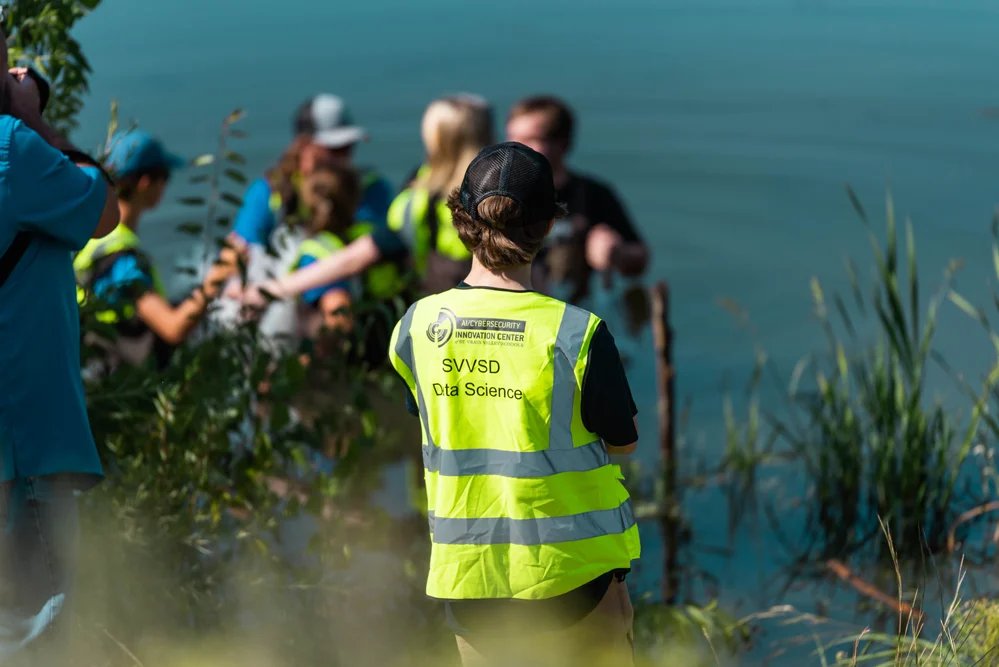
Because these frogs had never been raised in captivity before, the methods the students and scientists created would become a template for the future, if successful. Students and scientists worked side by side, Reitzig said, solving problems while fixing a community problem. The experiment was a success and the released frogs have started to self-populate again, Kobza said.
This program not only incorporated bioscientific research, but it forced students to work through a maze of local and state approval processes while also dealing with private landowners. Students continue to monitor the water temperatures where the frogs live and stay in contact with area scientists and farmers. “This is cutting edge environmental science,” said Kobza.
the و a و and – تفاصيل مهمة
Even if a student’s work doesn’t lead directly to a career, they still pick up skills they can use in other jobs, said Hilary Sontag, the Innovation Center’s executive director of advancement and strategic partnerships. After a female student won a state championship in welding, Sontag asked her if she was planning on becoming a welder, a potentially lucrative career.
The student quickly said no, but explained that she wanted to enter the military and train to become a cardiac surgeon. She said her welding experience would help sharpen her problem-solving chops and hone her motor skills.
a و to و her – تفاصيل مهمة
Another student, senior Mischa Nelson, began his work at the Innovation Center in cybersecurity, a field with a strong business representation in the greater Denver area. He took multiple classes, not only working with expensive machinery but also picking up industry recognized certifications.
He landed a summer internship with a local software company. When that ended, the company asked him to stay on as an employee, helping it run a large experiment to test its data security measures.
“I’m working on a program with than a million Social Security numbers in it,” he said.
But while Nelson continues to work for the cybersecurity company, he has broadened his Innovation Center studies to include entrepreneurship and AI. Through his AI work, he entered a NASA competition where he is trying to create a system that would offer astronauts immediate medical advice without requiring them to connect back to Earth. He credits his entrepreneurial classes with helping him develop time management skills and the confidence to present publicly to groups of people needed for this project.
to و a و he – تفاصيل مهمة
Once he graduates, he said he hopes to create and run control systems for industries that use robotics and computers in warehouses. “Everything I’ve learned is completely relevant,” he said.
“It’s not like we were doing old curriculum. You get to hone the way you want to go.”
to و “It’s و not – تفاصيل مهمة
Did you use this article in your work?
We’d love to hear how The 74’s reporting is helping educators, researchers, and policymakers.Tell us how
how و و We’d – تفاصيل مهمة
Disclaimer: This news article has been republished exactly as it appeared on its original source, without any modification.
We do not take any responsibility for its content, which remains solely the responsibility of the original publisher.
Author:Wayne D’Orio
Published on:2026-01-07 15:30:00
Source: www.the74million.org
Disclaimer: This news article has been republished exactly as it appeared on its original source, without any modification.
We do not take any responsibility for its content, which remains solely the responsibility of the original publisher.
Author: uaetodaynews
Published on: 2026-01-07 12:48:00
Source: uaetodaynews.com