
This Piece Of Cloth Keeps Restaurants From Descending Into Chaos
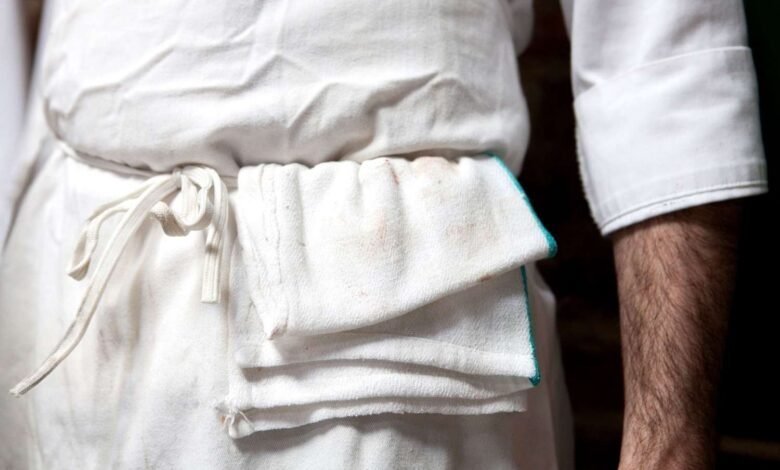
To keep any restaurant kitchen running smoothly, you rely on a few essential items. These include deli cups, Sharpiesgreen or blue painter’s tape, Cambros, and, most crucially, kitchen towels. You could survive if any of these other things went missing, at least for a bit, but no towels? Forget about it. By any other name — rags, bar mops, side towels — without them, you’re cooked.
Kitchen towels are used as potholders and for carrying hot things from one place to another. We use them as rags to wipe down and clean. We deploy them as traditional towels to dry our hands or to mop our brow. We soak them and freeze them to wrap around our necks during the hottest nights on the line. We wet them and place them underneath cutting boards to prevent slippage. We wrap them tightly over the Vitamix so the lid doesn’t blow off when we’re pureeing hot soup. We place them under the Robot Coupe to keep it steady during heavy aioli production. We wrap our knives in them. Towels are the backbone of service at virtually every restaurant.
them و to و We – تفاصيل مهمة
What purpose do towels play in a restaurant?
S&P Lunch is located in New York City’s Flatiron District. It’s a narrow footprint that houses a classic diner counter running the length of the building, with a small dining room in the back. It’s been open since 1928, and the team from Court Street Grocers stepped in to relaunch in 2022. They were mindful of the history and wanted to honor that, and as such, walking in feels like stepping back in time. The classic New York diner feel is further enhanced by the branding created by Tamara Shopsin, a New York–based illustrator and daughter of the legendarily curmudgeonly diner owner Kenny Shopsin.
“S&P is not trendy. We’re doing things exactly the way it’s been done for almost 100 years,” says chef Kirstyn Brewer. “We’re selling nostalgia, so we just need to tap into that. People have a very specific idea of what this is and what it’s going to taste like, and so we just need to give them the best version of it that we can. It’s very simple stuff.”
They not only get fresh bread trucked in from New Jersey every day; it’s sliced fresh, which is an important distinction, Brewer says. “We’re sourcing the best pastrami, turkey, everything that we can. And luckily we’re very, very busy, so it’s no problem keeping it really fresh.”
the و in و a – تفاصيل مهمة
When she says they’re busy, she means it. S&P has 45 seats. During a slow lunch service, they’ll serve 300 customers. That’s a typical Monday or Tuesday, she says. “On the weekends, we can do closer to five or six hundred people.”
Aiko Uchigoshi
Kitchen towels are the most essential item for any chef.
— Aiko Uchigoshi
Abile is located below a Chanel store, a few doors down from Tiffany & Co. in Toronto’s Yorkville Village. When the Michelin guide came to Canada in 2022, the Kyoto-style kaiseki was in the first group to receive a star. Like S&P, it has limited seating and a ravenous fan base. The race to get a reservation when the books open each month is intense, and they sell out in minutes. Their exquisite dishes are crafted like edible works of art, and they use some of the most expensive ingredients in the world. Both restaurants would screech to a halt without towels.
the و a و in – تفاصيل مهمة
“Kitchen towels are the most essential item for any chef,” says Aburi Hana’s executive pastry chef, Aiko Uchigoshi. “No matter where we move in the kitchen, we always carry our own towel with us.” She thinks of the towel as a kitchen tool in itself. “Towels help us do our work cleanly and precisely.”
Like S&P, the Aburi Hana kitchen team works in full view of the customers. Everything must be scrupulously clean, from the equipment to the staff themselves. While at S&P cooks can use as many rags as they need throughout a shift, at Aburi Hana they are limited.
How many towels are we talking about?
“For dinner service, we typically go through around 30 to 50 towels per night,” explains Uchigoshi. “When I first started my culinary career in a hotel kitchen in Tokyo, we followed very strict rules about towels. Each person received one disinfected towel per shift. Using someone else’s towel was not allowed, and we were always reminded to handle our tools, even something as simple as a towel, with care and respect.”
the و as و we – تفاصيل مهمة
For me, as a longtime restaurant worker, the thought of only one towel per shift seems impossible. I used to stash towels in my locker. All of us did. Our sous chef hid them in the ceiling tiles. If you looked in the filing cabinet in the kitchen office, there were no files, and instead you would find cookbooks, extra Sharpies, the mandoline guard, and a hidden stash of towels.
When Uchigoshi came to Canada, she saw a free-for-all when it came to towels in the kitchen. “At first that was surprising to me,” she said. “But I came to understand it as a very practical and efficient way of working. The focus tends to be on keeping things clean by replacing towels regularly, rather than setting limits on how many are used.”
Chef andThe Bearstar Matty Matheson’s restaurant empire currently includes the Prime Seafood Palace steakhouse (PSP), casual Vietnamese spot Roasted Coffeeburger joint Matty’s Pattysspaghetti house Rizzo’s House of Parmand the newly opened The Iron Cow Public Housewhich seats up to 185 people.
“We’ve been blowing through towels like nobody’s business. Just the sheer amount is wild at the moment, but it will even itself out,” says culinary director Coulson Armstrong, who oversees all of these very different establishments. He thinks about towels a lot.
to و the و towels – تفاصيل مهمة
Coulson Armstrong
When you’re opening a restaurant, you’re reminded how foundational the towel is to everything.
— Coulson Armstrong
“When you’re opening a restaurant, you’re reminded how foundational the towel is to everything,” he says. “We try to put an allowance on the Iron Cow cooks — four or six, depending on what station they’re on.”
“Our most important purveyor is our towel supplier,” Armstrong continues. “We’re calling him at 7 p.m. asking for towels. I talk about towels at least once a day in briefings — it’s just so important. We’re going through 400 towels a week; that’s a record amount of towels. I’ve never used that many in my career.”
a و — و Armstrong – تفاصيل مهمة
At S&P, the standing order is 400 a week. “I’m not nitpicky about giving people only a certain amount of towels a day,” says Brewer. “This can be a very greasy kitchen — we’re doing a lot of pastrami and a lot of burgers. Plus, it’s a 100-year-old building. We want to make sure everything stays as clean as possible.”
What kinds of towels are in play?
Armstrong recounts the types of towels used by each restaurant. “At PSP we have seven different types of towels: bar wipes, polishing rags, plate wipes, black towels. We also have half sheet trays that we line with thin cotton towels where chefs store their knives on the rolling racks. The green kitchen towels are only used for handling hot trays out of the oven.” Fluffy white ones, he notes, are strictly for cleaning.
In contrast, “At Iron Cow we’re only using the fluffy white towels for everything. At Rizzo’s, the red sauce gets on everything,” Armstrong says. “We use the thin white towels, and you know the giant clear bag of rags you can order? That’s what we use at Rizzo’s. We go through a lot of those, just constantly cleaning up red sauce.”
the و of و towels – تفاصيل مهمة
So who cleans all those towels?
Logistically, it would make sense for restaurants to clean their own towels, but this isn’t your everyday load of laundry. Towels and rags get soaked and slopped with all manner of impenetrable stains — from blood to beet juice to squid ink. The rag becomes an expense on the linens bill, and because costs keep rising, this is one line item a lot of restaurants would like to eliminate.
But throwing a load of blood- and grease-soaked rags into the washer and dryer is not necessarily going to result in a pile of fluffy white towels coming out the other end. Many restaurateurs have tried, and many have failed.
Brewer recalls a restaurant she worked at prior to S&P. “The owner really pushed the idea of laundering our own. I’ve never hated a process than that,” she says. “They had grease on them that would not come out, and they would be catching on fire in the dryer. We would soak them in bleach and other cleaners to try to get the grease out, and then we would be smelling chemicals all day long. It was toxic. Totally a failed experiment.”
and و to و would – تفاصيل مهمة
How much does all of that cost?
At S&P, they pay $0.32 per towel. If they lose a towel, there’s a $3 charge. Brewer has to keep on top of it, constantly checking the invoices from the linen company. “How did we lose 100 towels in a week?” But she doesn’t want her cooks worrying about that.
It’s possible that the memory of flaming rags spinning in the dryer early on in her career radicalized her. “I’d rather my cooks be worried about the guests, about the food, about keeping their station clean,” Brewer says. “If they ever need towels, then I’m going to get it for them.”
“In Japan, there’s a cultural idea called mottainai, which means not wasting things and treating them with appreciation,” explains Uchigoshi. “That’s why many Japanese chefs, including myself, tend to be mindful about how we use even small tools like towels.”
the و about و a – تفاصيل مهمة
Coulson Armstrong
Nobody can cook on two towels.
— Coulson Armstrong
Armstrong remembers starting out in his career in a kitchen where two towels was the standard for the shift. “Two towels is hard — nobody can cook on two towels. You’d hold onto them for dear life.” Like Uchigoshi in Japan, that limitation showed him the importance of the humble towel. “When I see towels that are barely used, I want to cry.”
For Brewer, there is a ripple effect that comes from mess. “If your hands aren’t clean, or your station’s not clean, then you’re going to be distracted,” she explains, and in any restaurant setting, there simply isn’t time for distraction. “That’s going to negatively affect your efficiency and the food you’re making.”
the و in و towels – تفاصيل مهمة
When you’re a cook serving 600 people a day in a space with 45 seats, there is not a second — or a towel — to spare.
Go Behind the Scenes at Restaurants
Disclaimer: This news article has been republished exactly as it appeared on its original source, without any modification.
We do not take any responsibility for its content, which remains solely the responsibility of the original publisher.
Disclaimer: This news article has been republished exactly as it appeared on its original source, without any modification.
We do not take any responsibility for its content, which remains solely the responsibility of the original publisher.
Author: uaetodaynews
Published on: 2025-12-23 17:33:00
Source: uaetodaynews.com