
Why Being A Black, Female Science Teacher Matters So Much To Students Who Look Like Me The 74
Get stories like this delivered straight to your inbox.Sign up for The 74 Newsletter
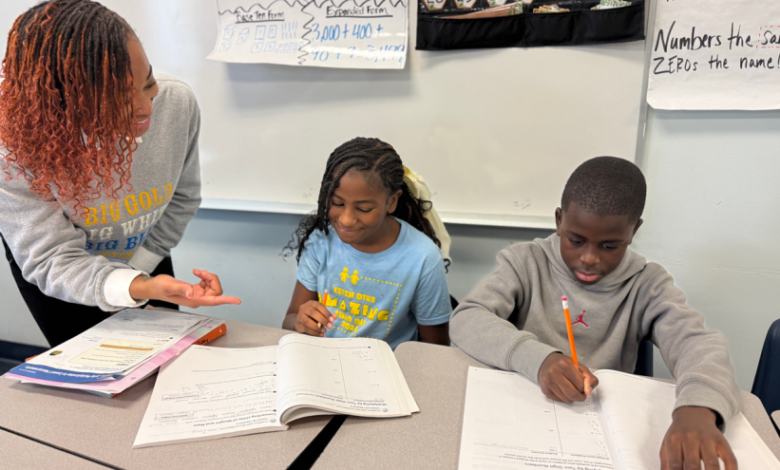
“What do you want to be when you grow up?”I asked my fourth graders as we circled up for our morning meeting.Hands shot up: doctor, basketball player, singer. Then, a student named Zoey Woods looked at me with a giant grin and said, “A teacher and a scientist, just like you.”
That stopped me in my tracks. She had seen me on my
“>▶ عرض المحتوى المضمّن
where I explore science and technology — and for which I was recently nominated for an Emmy for Outstanding Children’s Personality. Zoey had realized her teacher was also a scientist, guiding students through hands-on, real-world science, technology, engineering and mathematics challenges and helping to break down complex topics like microchips, circuits and semiconductors. For Zoey, the possibilities multiplied, with doors to her future opening simultaneously.
Women engineers are rare. Women scientists are rare. And women of color in those roles are even rarer. Women make up only 27% of the STEM workforceand women of color account for less than 10%.
Yet across Arkansas and the country, the teacher workforce does not reflect the diversity of America’s classrooms. About 40% of students identify as people of color, but only 12% of teachers do. Having even one Black teacher in elementary school reduces the chance of a Black student dropping out by nearly 40%.
Nationally, according to a report released in early Decemberabout 40% of teacher preparation programs aren’t producing graduating classes that are as diverse as their state’s educator workforce. I am a Black teacher, with about 76.5% of my school’s population students of color.
]
For Zoey to see me as both her teacher and a scientist wasn’t just encouraging — it was expanding what she believes she can be. If education leaders want students to see themselves as future teachers, engineers, and scientists, they must prioritize attracting and holding onto teachers of color in education.
Diversity in teaching and STEM is not just about who stands at the front of the classroom, but about who students believe they can become. Here are some ideas about how to make this happen:
Start recruitment early through real-world science experiences.
When my students watch me test circuits, build models or record for my PBS show, they begin to see what a scientist looks like in action. I bring STEM to life through explorations like mini solar cars and electricity. These moments make science feel reachable.
Schools can expand this sort of work by hosting STEM discovery weeks, funding afterschool clubs and highlighting diverse scientists. Early exposure is the first step to diversifying who enters the field.
Invest in future teachers by nurturing leadership in the classroom.
Representation begins with visibility, and teaching must be seen as a form of leadership. When I see a student helping a classmate, I say, “You just taught that.” For example, during a circuits lesson, one student finished his project early and helped a classmate whose lightbulb wouldn’t turn on; he realized that the switch was not connected to the wire and showed his friend how to fix it. Moments like that illustrate to students that teaching is influential.
I also give my students chances to lead mini-lessons or guide small groups. Schools could build on this by offering “Teacher for a Day” programs and electives that teach aspiring educators about child development, lesson planning and what it means to lead a classroom. These types of experiences plant early seeds for a diverse generation of educators.
Connect students with local professionals who look like them.
When students meet people who share their background doing meaningful work, it changes what they believe is possible. The look on my students’ faces when they see a woman of color leading a tech project or teaching in a lab says it all, and I often play episodes ofChip Kidsfor them because seeing a familiar face on the screen doing science projects makes that representation feel real.
Districts could partner with universities, nonprofits and businesses to create mentorship programs and speaker networks. When classrooms open their doors to diverse professionals, students gain both knowledge and belonging.
That morning meeting moment is one I will never forget. Zoey did not just share a dream — she saw herself in me. Because of that, her world of possibilities grew bigger.
If schools are serious about preparing students for college, career and life, they must be equally serious about teacher diversity. Education leaders must invest in recruitment pipelines and ensure that all children can look at their teacher and think, “That could be me someday.” Representation is the spark that ignites a lifetime of possibility.
Did you use this article in your work?
We’d love to hear how The 74’s reporting is helping educators, researchers, and policymakers.Tell us how
Disclaimer: This news article has been republished exactly as it appeared on its original source, without any modification.
We do not take any responsibility for its content, which remains solely the responsibility of the original publisher.
Disclaimer: This news article has been republished exactly as it appeared on its original source, without any modification.
We do not take any responsibility for its content, which remains solely the responsibility of the original publisher.
Author: uaetodaynews
Published on: 2025-12-25 22:25:00
Source: uaetodaynews.com